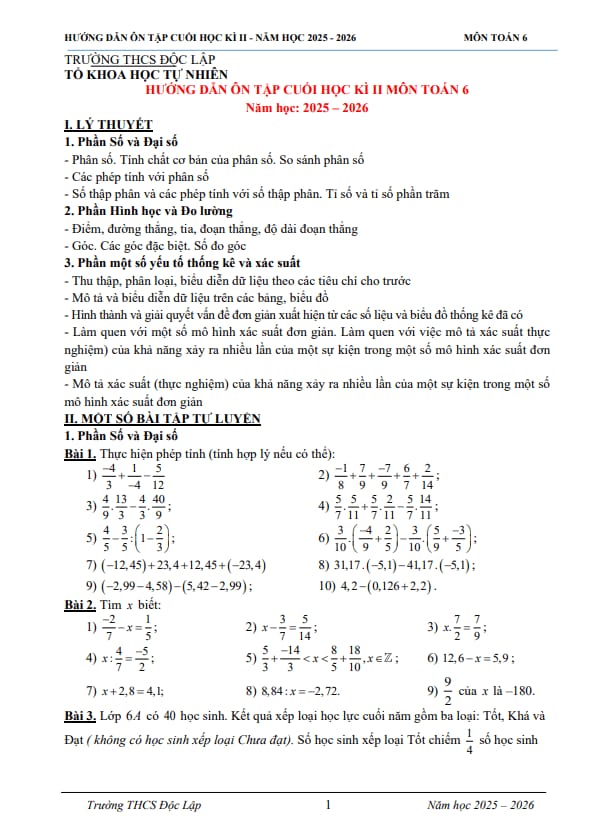
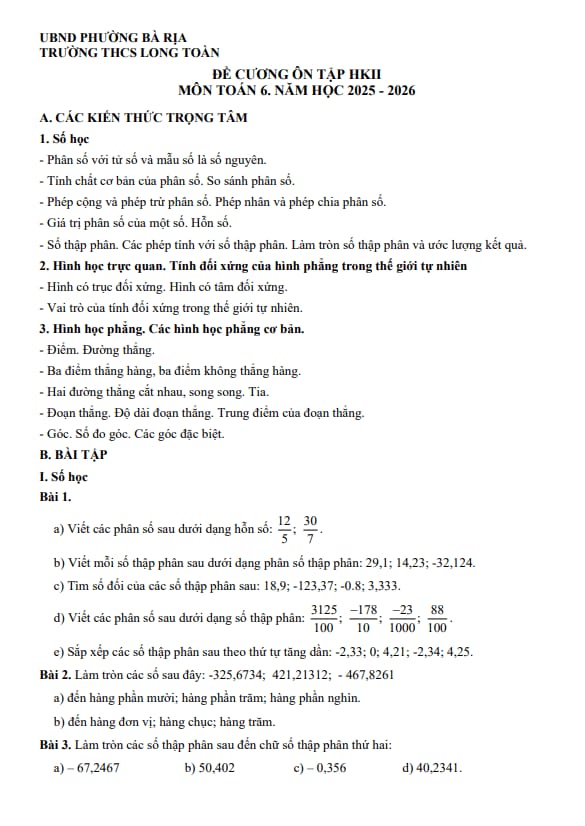
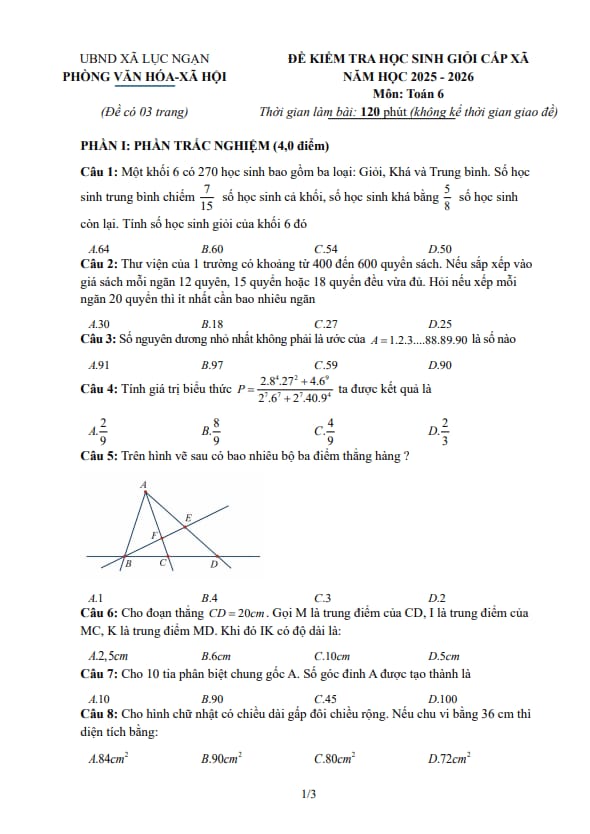
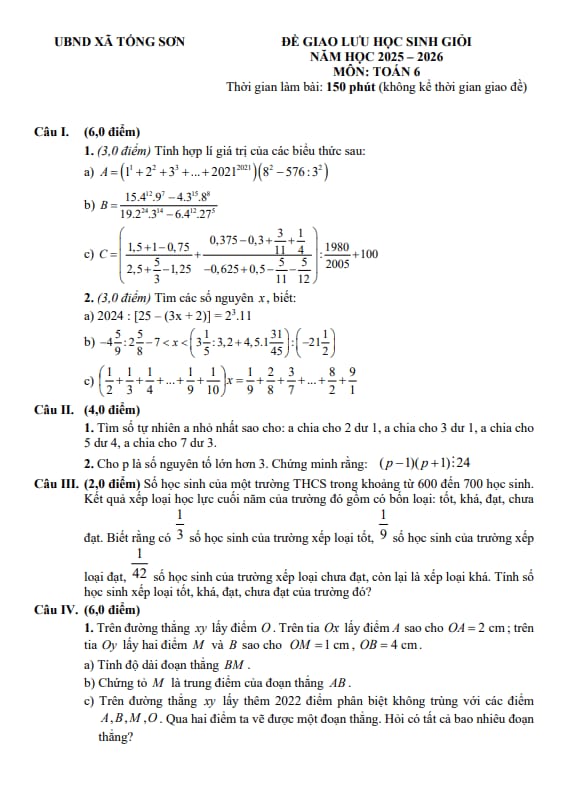
Chào mừng các em học sinh đến với bài học về Dạng 5. Tìm x trong Chủ đề 6 Ôn hè Toán 6 tại toan9.edu.vn. Đây là một trong những dạng toán quan trọng giúp các em rèn luyện kỹ năng giải phương trình đơn giản và tư duy logic.
Trong bài học này, chúng ta sẽ cùng nhau khám phá các phương pháp giải quyết các bài toán tìm x, từ những bài toán cơ bản đến những bài toán phức tạp hơn. Các em sẽ được cung cấp các ví dụ minh họa chi tiết và bài tập thực hành đa dạng để củng cố kiến thức.
Dùng quy tắc thực hiện phép tính, quy tắc chuyển vế, quy tắc dấu ngoặc để đưa về các dạng quen thuộc để tìm x:
Dùng quy tắc thực hiện phép tính, quy tắc chuyển vế, quy tắc dấu ngoặc để đưa về các dạng quen thuộc để tìm x:
1) \(x + a = b \)
\(x = b - a\)
2) \(x - a = b\)
\(x = b + a\)
3) \(a - x = b\)
\(x = a - b\)
4) \(a.x = b\)
\(x = \dfrac{b}{a}\)
5) \(a:x = b\)
\(x = \dfrac{a}{b}\)
6) \(x:a = b\)
\(x = a.b\)
7) \(\dfrac{a}{b} = \dfrac{x}{c}\)
\(x = \dfrac{{a.c}}{b}\)
8) \({x^2} = {a^2}\)
\({x = a}\) hoặc \({x = - a}\)
9) \({x^3} = {a^3}\)
\(x = a\)
Bài 1:
Tìm x, biết:
\(\begin{array}{l}a)2x + 3 = 1\dfrac{2}{3}\\b)0,15 - 3x = {( - 10)^0}\\c) - x:\dfrac{2}{5} = 0,8\\d)\dfrac{{3x + 2}}{3} = \dfrac{{ - 4}}{5}\\e)\dfrac{{3x + 2}}{{ - 8}} = \dfrac{{ - 2}}{{3x + 2}}\\f)\left( {x + 1} \right).\left( { - 2x - 3} \right) = 0\end{array}\)
Bài 2:
Tìm \(x\), biết:
a) \(\dfrac{1}{3}x + \dfrac{2}{5}\left( {x - 1} \right) = 0\)
b) \(3 \cdot {\left( {3x - \dfrac{1}{2}} \right)^3} + \dfrac{1}{9} = 0\)
c) \(3 \cdot \left( {1 - \dfrac{1}{2}} \right) - 5 \cdot \left( {x + \dfrac{3}{5}} \right) = {\rm{ \;}} - x + \dfrac{1}{5}\)
d) \(\dfrac{{3 - x}}{{5 - x}} = {\left( {\dfrac{{ - 3}}{5}} \right)^2}\)
e) \(x\;:\;\dfrac{5}{8} = \dfrac{{ - 13}}{{35}} \cdot \dfrac{{15}}{{ - 39}}\)
f) \(\left( {\dfrac{7}{5}\; + \;x} \right):\dfrac{{25}}{{16}} = \dfrac{{ - 4}}{5}\)
g) \( - 4:\left( {x + \dfrac{{ - 2}}{3}} \right) = \dfrac{3}{4}\)
h) \(\left( {\dfrac{{ - 1}}{5} + 2} \right):\left( {x - \dfrac{7}{{10}}} \right) = \dfrac{{ - 1}}{4}\)
Bài 3:
Tìm tập hợp các số nguyên x để: \(\dfrac{5}{6} + \dfrac{{ - 7}}{8} \le \dfrac{x}{{24}} \le \dfrac{{ - 5}}{{12}} + \dfrac{5}{8}\)
Lời giải chi tiết:
Bài 1:
Tìm x, biết:
\(\begin{array}{l}a)2x + 3 = 1\dfrac{2}{3}\\b)0,15 - 3x = {( - 10)^0}\\c) - x:\dfrac{2}{5} = 0,8\\d)\dfrac{{3x + 2}}{3} = \dfrac{{ - 4}}{5}\\e)\dfrac{{3x + 2}}{{ - 8}} = \dfrac{{ - 2}}{{3x + 2}}\\f)\left( {x + 1} \right).\left( { - 2x - 3} \right) = 0\end{array}\)
Phương pháp
Áp dụng quy tắc thực hiện phép tính, quy tắc chuyển vế, quy tắc dấu ngoặc để đưa về các dạng quen thuộc để tìm x.
Lời giải
\(\begin{array}{l}a)2x + 3 = 1\dfrac{2}{3}\\2x + 3 = \dfrac{5}{3}\\2x = \dfrac{5}{3} - 3\\2x = \dfrac{5}{3} - \dfrac{9}{3}\\2x = \dfrac{{ - 4}}{3}\\x = \dfrac{{ - 4}}{3}:2\\x = \dfrac{{ - 4}}{3}.\dfrac{1}{2}\\x = \dfrac{{ - 2}}{3}\end{array}\)
Vậy \(x = \dfrac{{ - 2}}{3}\)
\(\begin{array}{l}b)0,15 - 3x = {( - 10)^0}\\0,15 - 3x = 1\\3x = 0,15 - 1\\3x = -0,85\\3x = -\dfrac{{17}}{{20}}\\x = -\dfrac{{17}}{{20}}:3\\x = -\dfrac{{17}}{{20}}.\dfrac{1}{3}\\x = -\dfrac{{17}}{{60}}\end{array}\)
Vậy \(x = -\dfrac{{17}}{{60}}\)
\(\begin{array}{l}c) - x:\dfrac{2}{5} = 0,8\\ - x:0,4 = 0,8\\ - x = 0,8.0,4\\ - x = 0,32\\x = - 0,32\end{array}\)
Vậy x = -0,32
\(\begin{array}{l}d)\dfrac{{3x + 2}}{3} = \dfrac{{ - 4}}{5}\\5.(3x + 2) = 3.( - 4)\\15x + 10 = - 12\\15x = - 12 - 10\\15x = - 22\\x = \dfrac{{ - 22}}{{15}}\end{array}\)
Vậy \(x = \dfrac{{ - 22}}{{15}}\)
\(\begin{array}{l}e)\dfrac{{3x + 2}}{{ - 8}} = \dfrac{{ - 2}}{{3x + 2}}\\\left( {3x + 2} \right).\left( {3x + 2} \right) = ( - 8).( - 2)\\{\left( {3x + 2} \right)^2} = 16\\{\left( {3x + 2} \right)^2} = {4^2}\end{array}\)
\(3x + 2 = 4\) hoặc \(3x + 2 = - 4\)
\(3x = 2\) hoặc \(3x = - 6\)
\(x = \dfrac{2}{3}\) hoặc \(x = - 2\)
Vậy \(x \in \left\{ {\dfrac{2}{3}; - 2} \right\}\)
\(\begin{array}{l}f)\left( {x + 1} \right).\left( { - 2x - 3} \right) = 0\end{array}\)
\(x + 1 = 0\) hoặc \( - 2x - 3 = 0\)
\(x = - 1\) hoặc \(x = \dfrac{{ - 3}}{2}\)
Vậy \(x \in \left\{ { - 1;\dfrac{{ - 3}}{2}} \right\}\)
Bài 2:
Tìm \(x\), biết:
a) \(\dfrac{1}{3}x + \dfrac{2}{5}\left( {x - 1} \right) = 0\)
b) \(3 \cdot {\left( {3x - \dfrac{1}{2}} \right)^3} + \dfrac{1}{9} = 0\)
c) \(3 \cdot \left( {1 - \dfrac{1}{2}} \right) - 5 \cdot \left( {x + \dfrac{3}{5}} \right) = {\rm{ \;}} - x + \dfrac{1}{5}\)
d) \(\dfrac{{3 - x}}{{5 - x}} = {\left( {\dfrac{{ - 3}}{5}} \right)^2}\)
e) \(x\;:\;\dfrac{5}{8} = \dfrac{{ - 13}}{{35}} \cdot \dfrac{{15}}{{ - 39}}\)
f) \(\left( {\dfrac{7}{5}\; + \;x} \right):\dfrac{{25}}{{16}} = \dfrac{{ - 4}}{5}\)
g) \( - 4:\left( {x + \dfrac{{ - 2}}{3}} \right) = \dfrac{3}{4}\)
h) \(\left( {\dfrac{{ - 1}}{5} + 2} \right):\left( {x - \dfrac{7}{{10}}} \right) = \dfrac{{ - 1}}{4}\)
Phương pháp
Áp dụng các qui tắc cộng, trừ, nhân, chia phân số, qui tắc tính giá trị của biểu thức.
Lời giải
a) \(\dfrac{1}{3}x + \dfrac{2}{5}\left( {x - 1} \right) = 0\)
\(\begin{array}{l}\dfrac{1}{3}x + \dfrac{2}{5}x - \dfrac{2}{5} = 0\\\left( {\dfrac{1}{3} + \dfrac{2}{5}} \right)x = \dfrac{2}{5}\\\dfrac{{11}}{{15}}x = \dfrac{2}{5}\end{array}\)
\(x = \dfrac{2}{5}:\dfrac{{11}}{{15}}\)
\(\begin{array}{l}x = \dfrac{2}{5} \cdot \dfrac{{15}}{{11}}\\x = \dfrac{6}{{11}}\end{array}\)
Vậy \(x = \dfrac{6}{{11}} \cdot \)
b) \(3.{\left( {3x - \dfrac{1}{2}} \right)^3} + \dfrac{1}{9} = 0\)
\(\begin{array}{l}3.{\left( {3x - \dfrac{1}{2}} \right)^3} = - \dfrac{1}{9}\\{\left( {3x - \dfrac{1}{2}} \right)^3} = - \dfrac{1}{9}:3\\{\left( {3x - \dfrac{1}{2}} \right)^3} = - \dfrac{1}{{27}} = \left( {\dfrac{{ - 1}}{3}} \right)\end{array}\)
\( \Rightarrow 3x - \dfrac{1}{2} = {\dfrac{{ - 1}}{3}^3}\)
\(\begin{array}{l}{\kern 1pt} {\kern 1pt} {\kern 1pt} {\kern 1pt} {\kern 1pt} {\kern 1pt} {\kern 1pt} {\kern 1pt} {\kern 1pt} {\kern 1pt} {\kern 1pt} {\kern 1pt} 3x = \dfrac{{ - 1}}{3} + \dfrac{1}{2}{\kern 1pt} {\kern 1pt} \\{\kern 1pt} {\kern 1pt} {\kern 1pt} {\kern 1pt} {\kern 1pt} {\kern 1pt} {\kern 1pt} {\kern 1pt} {\kern 1pt} {\kern 1pt} {\kern 1pt} {\kern 1pt} 3x = \dfrac{{ - 2}}{6} + \dfrac{3}{6}\\{\kern 1pt} {\kern 1pt} {\kern 1pt} {\kern 1pt} {\kern 1pt} {\kern 1pt} {\kern 1pt} {\kern 1pt} {\kern 1pt} {\kern 1pt} {\kern 1pt} {\kern 1pt} {\kern 1pt} {\kern 1pt} 3x = \dfrac{1}{6}{\kern 1pt} {\kern 1pt} \\{\kern 1pt} {\kern 1pt} {\kern 1pt} {\kern 1pt} {\kern 1pt} {\kern 1pt} {\kern 1pt} {\kern 1pt} {\kern 1pt} {\kern 1pt} {\kern 1pt} {\kern 1pt} {\kern 1pt} {\kern 1pt} {\kern 1pt} {\kern 1pt} x = \dfrac{1}{{18}}\end{array}\)
Vậy \(x = \dfrac{1}{{18}} \cdot \)
c) \(3.\left( {1 - \dfrac{1}{2}} \right) - 5\left( {x + \dfrac{3}{5}} \right) = {\rm{ \;}} - x + \dfrac{1}{5}\)
\(\begin{array}{*{20}{l}}{3 - \dfrac{3}{2} - \left( {5x + 5.\dfrac{3}{5}} \right) = {\rm{ \;}} - x + \dfrac{1}{5}}\\{\dfrac{3}{2} - 5x - 3 = {\rm{ \;}} - x + \dfrac{1}{5}}\\{ - 5x + x = \dfrac{1}{5} - \dfrac{3}{2} + 3}\end{array}\)
\(\begin{array}{*{20}{l}}{ - 4x = \dfrac{{ - 13}}{{10}} + 3}\\{ - 4x = \dfrac{{17}}{{10}}}\\{x = \dfrac{{17}}{{10}}:\left( { - 4} \right)}\\{x = {\rm{ \;}} - \dfrac{{17}}{{40}}}\end{array}\)
Vậy \(x = {\rm{ \;}} - \dfrac{{17}}{{40}} \cdot \)
d) \(\dfrac{{3 - x}}{{5 - x}} = {\left( {\dfrac{{ - 3}}{5}} \right)^2}\)
Điều kiện: \(5 - x \ne 0 \Leftrightarrow x \ne 5.\)
\(\begin{array}{*{20}{l}}{ \Rightarrow \dfrac{{3 - x}}{{5 - x}} = \dfrac{9}{{25}}}\\{ \Rightarrow \left( {3 - x} \right).25 = 9.\left( {5 - x} \right)}\\{{\kern 1pt} {\kern 1pt} {\kern 1pt} {\kern 1pt} {\kern 1pt} {\kern 1pt} {\kern 1pt} {\kern 1pt} {\kern 1pt} 75 - 25x = 45 - 9x{\kern 1pt} }\\{{\kern 1pt} {\kern 1pt} {\kern 1pt} {\kern 1pt} {\kern 1pt} - 25x + 9x = 45 - 75}\\{{\kern 1pt} {\kern 1pt} {\kern 1pt} {\kern 1pt} {\kern 1pt} {\kern 1pt} {\kern 1pt} {\kern 1pt} {\kern 1pt} {\kern 1pt} {\kern 1pt} {\kern 1pt} {\kern 1pt} {\kern 1pt} {\kern 1pt} - 16x = {\rm{ \;}} - 30}\\{{\kern 1pt} {\kern 1pt} {\kern 1pt} {\kern 1pt} {\kern 1pt} {\kern 1pt} {\kern 1pt} {\kern 1pt} {\kern 1pt} {\kern 1pt} {\kern 1pt} {\kern 1pt} {\kern 1pt} {\kern 1pt} {\kern 1pt} {\kern 1pt} {\kern 1pt} {\kern 1pt} {\kern 1pt} {\kern 1pt} {\kern 1pt} {\kern 1pt} {\kern 1pt} {\kern 1pt} x = \dfrac{{ - 30}}{{ - 16}} = \dfrac{{15}}{8}}\end{array}\)
Vậy \(x = \dfrac{{15}}{8} \cdot \)
e) \(x\;:\;\dfrac{5}{8} = \dfrac{{ - 13}}{{35}} \cdot \dfrac{{15}}{{ - 39}}\)
\(\begin{array}{*{20}{l}}{x:\dfrac{5}{8} = \dfrac{1}{7}}\\{x\;\;\;\;\; = \dfrac{1}{7} \cdot \dfrac{5}{8}}\\{x\;\;\;\;\; = \dfrac{5}{{56}}.}\end{array}\)
Vậy \(x = \dfrac{5}{{56}}\)
f) \(\left( {\dfrac{7}{5}\; + \;x} \right):\dfrac{{25}}{{16}} = \dfrac{{ - 4}}{5}\)
\(\begin{array}{*{20}{l}}{\dfrac{7}{5}\; + \;x\;\;\;\;\;\;\;\;\;\; = \dfrac{{ - 4}}{5} \cdot \dfrac{{25}}{{16}}}\\{\dfrac{7}{5}\; + \;x\;\;\;\;\;\;\;\;\;\; = \dfrac{{ - 5}}{4}}\\{\;\;{\kern 1pt} {\kern 1pt} {\kern 1pt} {\kern 1pt} {\kern 1pt} {\kern 1pt} {\kern 1pt} x\;\;\;\;\;\;\;\;\;\; = \dfrac{{ - 5}}{4} - \dfrac{7}{5}}\\{\;\;\;\;\;\;x\;\;\;\;\;\;\;\;\;\; = \dfrac{{ - 53}}{{20}}.}\end{array}\)
Vậy \(x = \dfrac{{ - 53}}{{20}}\).
g) \( - 4:\left( {x + \dfrac{{ - 2}}{3}} \right) = \dfrac{3}{4}\)
\(\begin{array}{*{20}{l}}{\;\;\;\;\;\;\;\;\;\;\;x + \dfrac{{ - 2}}{3} = {\rm{ \;}} - 4:\dfrac{3}{4}}\\{\;\;\;\;\;\;\;\;\;\;\;x + \dfrac{{ - 2}}{3} = {\rm{ \;}} - 4.\dfrac{4}{3}}\\{\;\;\;\;\;\;\;\;\;\;\;x + \dfrac{{ - 2}}{3} = \dfrac{{ - 16}}{3}}\\{\;\;\;\;\;\;\;\;\;\;\;x\;\;\;\;\;\;\;\; = \dfrac{{ - 16}}{3} - \left( {\dfrac{{ - 2}}{3}} \right)}\\{\;\;\;\;\;\;\;\;\;\;\;x\;\;\;\;\;\;\;\; = \dfrac{{ - 14}}{3}.}\end{array}\)
Vậy \(x = \dfrac{{ - 14}}{3}\).
h) \(\left( {\dfrac{{ - 1}}{5} + 2} \right):\left( {x - \dfrac{7}{{10}}} \right) = \dfrac{{ - 1}}{4}\)
\(\dfrac{{ - 1 + 10}}{5}:\left( {x - \dfrac{7}{{10}}} \right) = \dfrac{{ - 1}}{4}\)
\(\begin{array}{*{20}{l}}{\;\;\;\;\dfrac{9}{5}:\left( {x - \dfrac{7}{{10}}} \right) = \dfrac{{ - 1}}{4}}\\{\;\;\;\;\;\;\;\;\;\;x - \dfrac{7}{{10}} = \dfrac{9}{5}:\dfrac{{ - 1}}{4}}\\{\;\;\;\;\;\;\;\;\;\;x - \dfrac{7}{{10}} = \dfrac{9}{5}.\left( { - 4} \right)}\\{\;\;\;\;\;\;\;\;\;\;x - \dfrac{7}{{10}} = \dfrac{{ - 36}}{5}}\\{\;\;\;\;\;\;\;\;\;\;x\;\;\;\;\;\;\;\; = \dfrac{{ - 36}}{5} + \dfrac{7}{{10}}}\\{\;\;\;\;\;\;\;\;\;\;x\;\;\;\;\;\;\;\; = \dfrac{{ - 13}}{2}.}\end{array}\)
Vậy \(x = \dfrac{{ - 13}}{2}\)
Bài 3:
Tìm tập hợp các số nguyên x để: \(\dfrac{5}{6} + \dfrac{{ - 7}}{8} \le \dfrac{x}{{24}} \le \dfrac{{ - 5}}{{12}} + \dfrac{5}{8}\)
Phương pháp
+ Thực hiện phép cộng các phân số đã biết.
+ Xác định vai trò của số chưa biết trong phép toán rồi kết luận.
Lời giải
\(\begin{array}{*{20}{l}}{\dfrac{5}{6} + \dfrac{{ - 7}}{8} \le \dfrac{x}{{24}} \le \dfrac{{ - 5}}{{12}} + \dfrac{5}{8}}\\{ \Rightarrow \dfrac{{ - 1}}{{24}} \le \dfrac{x}{{24}} \le \dfrac{5}{{24}}}\\{ \Rightarrow {\rm{ \;}} - 1 \le x \le 5}\end{array}\)
Vì \(x \in \mathbb{Z}\) nên \(x \in \left\{ { - 1;0;1;2;3;4;5} \right\}\)
Vậy \(x \in \left\{ { - 1;0;1;2;3;4;5} \right\}\)
Dùng quy tắc thực hiện phép tính, quy tắc chuyển vế, quy tắc dấu ngoặc để đưa về các dạng quen thuộc để tìm x:
1) \(x + a = b \)
\(x = b - a\)
2) \(x - a = b\)
\(x = b + a\)
3) \(a - x = b\)
\(x = a - b\)
4) \(a.x = b\)
\(x = \dfrac{b}{a}\)
5) \(a:x = b\)
\(x = \dfrac{a}{b}\)
6) \(x:a = b\)
\(x = a.b\)
7) \(\dfrac{a}{b} = \dfrac{x}{c}\)
\(x = \dfrac{{a.c}}{b}\)
8) \({x^2} = {a^2}\)
\({x = a}\) hoặc \({x = - a}\)
9) \({x^3} = {a^3}\)
\(x = a\)
Bài 1:
Tìm x, biết:
\(\begin{array}{l}a)2x + 3 = 1\dfrac{2}{3}\\b)0,15 - 3x = {( - 10)^0}\\c) - x:\dfrac{2}{5} = 0,8\\d)\dfrac{{3x + 2}}{3} = \dfrac{{ - 4}}{5}\\e)\dfrac{{3x + 2}}{{ - 8}} = \dfrac{{ - 2}}{{3x + 2}}\\f)\left( {x + 1} \right).\left( { - 2x - 3} \right) = 0\end{array}\)
Bài 2:
Tìm \(x\), biết:
a) \(\dfrac{1}{3}x + \dfrac{2}{5}\left( {x - 1} \right) = 0\)
b) \(3 \cdot {\left( {3x - \dfrac{1}{2}} \right)^3} + \dfrac{1}{9} = 0\)
c) \(3 \cdot \left( {1 - \dfrac{1}{2}} \right) - 5 \cdot \left( {x + \dfrac{3}{5}} \right) = {\rm{ \;}} - x + \dfrac{1}{5}\)
d) \(\dfrac{{3 - x}}{{5 - x}} = {\left( {\dfrac{{ - 3}}{5}} \right)^2}\)
e) \(x\;:\;\dfrac{5}{8} = \dfrac{{ - 13}}{{35}} \cdot \dfrac{{15}}{{ - 39}}\)
f) \(\left( {\dfrac{7}{5}\; + \;x} \right):\dfrac{{25}}{{16}} = \dfrac{{ - 4}}{5}\)
g) \( - 4:\left( {x + \dfrac{{ - 2}}{3}} \right) = \dfrac{3}{4}\)
h) \(\left( {\dfrac{{ - 1}}{5} + 2} \right):\left( {x - \dfrac{7}{{10}}} \right) = \dfrac{{ - 1}}{4}\)
Bài 3:
Tìm tập hợp các số nguyên x để: \(\dfrac{5}{6} + \dfrac{{ - 7}}{8} \le \dfrac{x}{{24}} \le \dfrac{{ - 5}}{{12}} + \dfrac{5}{8}\)
Lời giải chi tiết:
Bài 1:
Tìm x, biết:
\(\begin{array}{l}a)2x + 3 = 1\dfrac{2}{3}\\b)0,15 - 3x = {( - 10)^0}\\c) - x:\dfrac{2}{5} = 0,8\\d)\dfrac{{3x + 2}}{3} = \dfrac{{ - 4}}{5}\\e)\dfrac{{3x + 2}}{{ - 8}} = \dfrac{{ - 2}}{{3x + 2}}\\f)\left( {x + 1} \right).\left( { - 2x - 3} \right) = 0\end{array}\)
Phương pháp
Áp dụng quy tắc thực hiện phép tính, quy tắc chuyển vế, quy tắc dấu ngoặc để đưa về các dạng quen thuộc để tìm x.
Lời giải
\(\begin{array}{l}a)2x + 3 = 1\dfrac{2}{3}\\2x + 3 = \dfrac{5}{3}\\2x = \dfrac{5}{3} - 3\\2x = \dfrac{5}{3} - \dfrac{9}{3}\\2x = \dfrac{{ - 4}}{3}\\x = \dfrac{{ - 4}}{3}:2\\x = \dfrac{{ - 4}}{3}.\dfrac{1}{2}\\x = \dfrac{{ - 2}}{3}\end{array}\)
Vậy \(x = \dfrac{{ - 2}}{3}\)
\(\begin{array}{l}b)0,15 - 3x = {( - 10)^0}\\0,15 - 3x = 1\\3x = 0,15 - 1\\3x = -0,85\\3x = -\dfrac{{17}}{{20}}\\x = -\dfrac{{17}}{{20}}:3\\x = -\dfrac{{17}}{{20}}.\dfrac{1}{3}\\x = -\dfrac{{17}}{{60}}\end{array}\)
Vậy \(x = -\dfrac{{17}}{{60}}\)
\(\begin{array}{l}c) - x:\dfrac{2}{5} = 0,8\\ - x:0,4 = 0,8\\ - x = 0,8.0,4\\ - x = 0,32\\x = - 0,32\end{array}\)
Vậy x = -0,32
\(\begin{array}{l}d)\dfrac{{3x + 2}}{3} = \dfrac{{ - 4}}{5}\\5.(3x + 2) = 3.( - 4)\\15x + 10 = - 12\\15x = - 12 - 10\\15x = - 22\\x = \dfrac{{ - 22}}{{15}}\end{array}\)
Vậy \(x = \dfrac{{ - 22}}{{15}}\)
\(\begin{array}{l}e)\dfrac{{3x + 2}}{{ - 8}} = \dfrac{{ - 2}}{{3x + 2}}\\\left( {3x + 2} \right).\left( {3x + 2} \right) = ( - 8).( - 2)\\{\left( {3x + 2} \right)^2} = 16\\{\left( {3x + 2} \right)^2} = {4^2}\end{array}\)
\(3x + 2 = 4\) hoặc \(3x + 2 = - 4\)
\(3x = 2\) hoặc \(3x = - 6\)
\(x = \dfrac{2}{3}\) hoặc \(x = - 2\)
Vậy \(x \in \left\{ {\dfrac{2}{3}; - 2} \right\}\)
\(\begin{array}{l}f)\left( {x + 1} \right).\left( { - 2x - 3} \right) = 0\end{array}\)
\(x + 1 = 0\) hoặc \( - 2x - 3 = 0\)
\(x = - 1\) hoặc \(x = \dfrac{{ - 3}}{2}\)
Vậy \(x \in \left\{ { - 1;\dfrac{{ - 3}}{2}} \right\}\)
Bài 2:
Tìm \(x\), biết:
a) \(\dfrac{1}{3}x + \dfrac{2}{5}\left( {x - 1} \right) = 0\)
b) \(3 \cdot {\left( {3x - \dfrac{1}{2}} \right)^3} + \dfrac{1}{9} = 0\)
c) \(3 \cdot \left( {1 - \dfrac{1}{2}} \right) - 5 \cdot \left( {x + \dfrac{3}{5}} \right) = {\rm{ \;}} - x + \dfrac{1}{5}\)
d) \(\dfrac{{3 - x}}{{5 - x}} = {\left( {\dfrac{{ - 3}}{5}} \right)^2}\)
e) \(x\;:\;\dfrac{5}{8} = \dfrac{{ - 13}}{{35}} \cdot \dfrac{{15}}{{ - 39}}\)
f) \(\left( {\dfrac{7}{5}\; + \;x} \right):\dfrac{{25}}{{16}} = \dfrac{{ - 4}}{5}\)
g) \( - 4:\left( {x + \dfrac{{ - 2}}{3}} \right) = \dfrac{3}{4}\)
h) \(\left( {\dfrac{{ - 1}}{5} + 2} \right):\left( {x - \dfrac{7}{{10}}} \right) = \dfrac{{ - 1}}{4}\)
Phương pháp
Áp dụng các qui tắc cộng, trừ, nhân, chia phân số, qui tắc tính giá trị của biểu thức.
Lời giải
a) \(\dfrac{1}{3}x + \dfrac{2}{5}\left( {x - 1} \right) = 0\)
\(\begin{array}{l}\dfrac{1}{3}x + \dfrac{2}{5}x - \dfrac{2}{5} = 0\\\left( {\dfrac{1}{3} + \dfrac{2}{5}} \right)x = \dfrac{2}{5}\\\dfrac{{11}}{{15}}x = \dfrac{2}{5}\end{array}\)
\(x = \dfrac{2}{5}:\dfrac{{11}}{{15}}\)
\(\begin{array}{l}x = \dfrac{2}{5} \cdot \dfrac{{15}}{{11}}\\x = \dfrac{6}{{11}}\end{array}\)
Vậy \(x = \dfrac{6}{{11}} \cdot \)
b) \(3.{\left( {3x - \dfrac{1}{2}} \right)^3} + \dfrac{1}{9} = 0\)
\(\begin{array}{l}3.{\left( {3x - \dfrac{1}{2}} \right)^3} = - \dfrac{1}{9}\\{\left( {3x - \dfrac{1}{2}} \right)^3} = - \dfrac{1}{9}:3\\{\left( {3x - \dfrac{1}{2}} \right)^3} = - \dfrac{1}{{27}} = \left( {\dfrac{{ - 1}}{3}} \right)\end{array}\)
\( \Rightarrow 3x - \dfrac{1}{2} = {\dfrac{{ - 1}}{3}^3}\)
\(\begin{array}{l}{\kern 1pt} {\kern 1pt} {\kern 1pt} {\kern 1pt} {\kern 1pt} {\kern 1pt} {\kern 1pt} {\kern 1pt} {\kern 1pt} {\kern 1pt} {\kern 1pt} {\kern 1pt} 3x = \dfrac{{ - 1}}{3} + \dfrac{1}{2}{\kern 1pt} {\kern 1pt} \\{\kern 1pt} {\kern 1pt} {\kern 1pt} {\kern 1pt} {\kern 1pt} {\kern 1pt} {\kern 1pt} {\kern 1pt} {\kern 1pt} {\kern 1pt} {\kern 1pt} {\kern 1pt} 3x = \dfrac{{ - 2}}{6} + \dfrac{3}{6}\\{\kern 1pt} {\kern 1pt} {\kern 1pt} {\kern 1pt} {\kern 1pt} {\kern 1pt} {\kern 1pt} {\kern 1pt} {\kern 1pt} {\kern 1pt} {\kern 1pt} {\kern 1pt} {\kern 1pt} {\kern 1pt} 3x = \dfrac{1}{6}{\kern 1pt} {\kern 1pt} \\{\kern 1pt} {\kern 1pt} {\kern 1pt} {\kern 1pt} {\kern 1pt} {\kern 1pt} {\kern 1pt} {\kern 1pt} {\kern 1pt} {\kern 1pt} {\kern 1pt} {\kern 1pt} {\kern 1pt} {\kern 1pt} {\kern 1pt} {\kern 1pt} x = \dfrac{1}{{18}}\end{array}\)
Vậy \(x = \dfrac{1}{{18}} \cdot \)
c) \(3.\left( {1 - \dfrac{1}{2}} \right) - 5\left( {x + \dfrac{3}{5}} \right) = {\rm{ \;}} - x + \dfrac{1}{5}\)
\(\begin{array}{*{20}{l}}{3 - \dfrac{3}{2} - \left( {5x + 5.\dfrac{3}{5}} \right) = {\rm{ \;}} - x + \dfrac{1}{5}}\\{\dfrac{3}{2} - 5x - 3 = {\rm{ \;}} - x + \dfrac{1}{5}}\\{ - 5x + x = \dfrac{1}{5} - \dfrac{3}{2} + 3}\end{array}\)
\(\begin{array}{*{20}{l}}{ - 4x = \dfrac{{ - 13}}{{10}} + 3}\\{ - 4x = \dfrac{{17}}{{10}}}\\{x = \dfrac{{17}}{{10}}:\left( { - 4} \right)}\\{x = {\rm{ \;}} - \dfrac{{17}}{{40}}}\end{array}\)
Vậy \(x = {\rm{ \;}} - \dfrac{{17}}{{40}} \cdot \)
d) \(\dfrac{{3 - x}}{{5 - x}} = {\left( {\dfrac{{ - 3}}{5}} \right)^2}\)
Điều kiện: \(5 - x \ne 0 \Leftrightarrow x \ne 5.\)
\(\begin{array}{*{20}{l}}{ \Rightarrow \dfrac{{3 - x}}{{5 - x}} = \dfrac{9}{{25}}}\\{ \Rightarrow \left( {3 - x} \right).25 = 9.\left( {5 - x} \right)}\\{{\kern 1pt} {\kern 1pt} {\kern 1pt} {\kern 1pt} {\kern 1pt} {\kern 1pt} {\kern 1pt} {\kern 1pt} {\kern 1pt} 75 - 25x = 45 - 9x{\kern 1pt} }\\{{\kern 1pt} {\kern 1pt} {\kern 1pt} {\kern 1pt} {\kern 1pt} - 25x + 9x = 45 - 75}\\{{\kern 1pt} {\kern 1pt} {\kern 1pt} {\kern 1pt} {\kern 1pt} {\kern 1pt} {\kern 1pt} {\kern 1pt} {\kern 1pt} {\kern 1pt} {\kern 1pt} {\kern 1pt} {\kern 1pt} {\kern 1pt} {\kern 1pt} - 16x = {\rm{ \;}} - 30}\\{{\kern 1pt} {\kern 1pt} {\kern 1pt} {\kern 1pt} {\kern 1pt} {\kern 1pt} {\kern 1pt} {\kern 1pt} {\kern 1pt} {\kern 1pt} {\kern 1pt} {\kern 1pt} {\kern 1pt} {\kern 1pt} {\kern 1pt} {\kern 1pt} {\kern 1pt} {\kern 1pt} {\kern 1pt} {\kern 1pt} {\kern 1pt} {\kern 1pt} {\kern 1pt} {\kern 1pt} x = \dfrac{{ - 30}}{{ - 16}} = \dfrac{{15}}{8}}\end{array}\)
Vậy \(x = \dfrac{{15}}{8} \cdot \)
e) \(x\;:\;\dfrac{5}{8} = \dfrac{{ - 13}}{{35}} \cdot \dfrac{{15}}{{ - 39}}\)
\(\begin{array}{*{20}{l}}{x:\dfrac{5}{8} = \dfrac{1}{7}}\\{x\;\;\;\;\; = \dfrac{1}{7} \cdot \dfrac{5}{8}}\\{x\;\;\;\;\; = \dfrac{5}{{56}}.}\end{array}\)
Vậy \(x = \dfrac{5}{{56}}\)
f) \(\left( {\dfrac{7}{5}\; + \;x} \right):\dfrac{{25}}{{16}} = \dfrac{{ - 4}}{5}\)
\(\begin{array}{*{20}{l}}{\dfrac{7}{5}\; + \;x\;\;\;\;\;\;\;\;\;\; = \dfrac{{ - 4}}{5} \cdot \dfrac{{25}}{{16}}}\\{\dfrac{7}{5}\; + \;x\;\;\;\;\;\;\;\;\;\; = \dfrac{{ - 5}}{4}}\\{\;\;{\kern 1pt} {\kern 1pt} {\kern 1pt} {\kern 1pt} {\kern 1pt} {\kern 1pt} {\kern 1pt} x\;\;\;\;\;\;\;\;\;\; = \dfrac{{ - 5}}{4} - \dfrac{7}{5}}\\{\;\;\;\;\;\;x\;\;\;\;\;\;\;\;\;\; = \dfrac{{ - 53}}{{20}}.}\end{array}\)
Vậy \(x = \dfrac{{ - 53}}{{20}}\).
g) \( - 4:\left( {x + \dfrac{{ - 2}}{3}} \right) = \dfrac{3}{4}\)
\(\begin{array}{*{20}{l}}{\;\;\;\;\;\;\;\;\;\;\;x + \dfrac{{ - 2}}{3} = {\rm{ \;}} - 4:\dfrac{3}{4}}\\{\;\;\;\;\;\;\;\;\;\;\;x + \dfrac{{ - 2}}{3} = {\rm{ \;}} - 4.\dfrac{4}{3}}\\{\;\;\;\;\;\;\;\;\;\;\;x + \dfrac{{ - 2}}{3} = \dfrac{{ - 16}}{3}}\\{\;\;\;\;\;\;\;\;\;\;\;x\;\;\;\;\;\;\;\; = \dfrac{{ - 16}}{3} - \left( {\dfrac{{ - 2}}{3}} \right)}\\{\;\;\;\;\;\;\;\;\;\;\;x\;\;\;\;\;\;\;\; = \dfrac{{ - 14}}{3}.}\end{array}\)
Vậy \(x = \dfrac{{ - 14}}{3}\).
h) \(\left( {\dfrac{{ - 1}}{5} + 2} \right):\left( {x - \dfrac{7}{{10}}} \right) = \dfrac{{ - 1}}{4}\)
\(\dfrac{{ - 1 + 10}}{5}:\left( {x - \dfrac{7}{{10}}} \right) = \dfrac{{ - 1}}{4}\)
\(\begin{array}{*{20}{l}}{\;\;\;\;\dfrac{9}{5}:\left( {x - \dfrac{7}{{10}}} \right) = \dfrac{{ - 1}}{4}}\\{\;\;\;\;\;\;\;\;\;\;x - \dfrac{7}{{10}} = \dfrac{9}{5}:\dfrac{{ - 1}}{4}}\\{\;\;\;\;\;\;\;\;\;\;x - \dfrac{7}{{10}} = \dfrac{9}{5}.\left( { - 4} \right)}\\{\;\;\;\;\;\;\;\;\;\;x - \dfrac{7}{{10}} = \dfrac{{ - 36}}{5}}\\{\;\;\;\;\;\;\;\;\;\;x\;\;\;\;\;\;\;\; = \dfrac{{ - 36}}{5} + \dfrac{7}{{10}}}\\{\;\;\;\;\;\;\;\;\;\;x\;\;\;\;\;\;\;\; = \dfrac{{ - 13}}{2}.}\end{array}\)
Vậy \(x = \dfrac{{ - 13}}{2}\)
Bài 3:
Tìm tập hợp các số nguyên x để: \(\dfrac{5}{6} + \dfrac{{ - 7}}{8} \le \dfrac{x}{{24}} \le \dfrac{{ - 5}}{{12}} + \dfrac{5}{8}\)
Phương pháp
+ Thực hiện phép cộng các phân số đã biết.
+ Xác định vai trò của số chưa biết trong phép toán rồi kết luận.
Lời giải
\(\begin{array}{*{20}{l}}{\dfrac{5}{6} + \dfrac{{ - 7}}{8} \le \dfrac{x}{{24}} \le \dfrac{{ - 5}}{{12}} + \dfrac{5}{8}}\\{ \Rightarrow \dfrac{{ - 1}}{{24}} \le \dfrac{x}{{24}} \le \dfrac{5}{{24}}}\\{ \Rightarrow {\rm{ \;}} - 1 \le x \le 5}\end{array}\)
Vì \(x \in \mathbb{Z}\) nên \(x \in \left\{ { - 1;0;1;2;3;4;5} \right\}\)
Vậy \(x \in \left\{ { - 1;0;1;2;3;4;5} \right\}\)
Dạng toán “Tìm x” trong chương trình Toán 6, đặc biệt là trong giai đoạn ôn hè, đóng vai trò quan trọng trong việc xây dựng nền tảng tư duy logic và kỹ năng giải toán. Dạng toán này tập trung vào việc xác định giá trị ẩn của biến x, thỏa mãn một điều kiện hoặc phương trình cho trước. Việc nắm vững các phương pháp giải quyết dạng toán này không chỉ giúp học sinh đạt kết quả tốt trong các bài kiểm tra mà còn là bước đệm quan trọng cho các kiến thức toán học nâng cao hơn.
Ví dụ 1: Giải phương trình x + 7 = 12
Giải:
x + 7 = 12
x = 12 - 7
x = 5
Kiểm tra: 5 + 7 = 12 (đúng)
Ví dụ 2: Giải phương trình 2x - 4 = 6
Giải:
2x - 4 = 6
2x = 6 + 4
2x = 10
x = 10 / 2
x = 5
Kiểm tra: 2 * 5 - 4 = 6 (đúng)
Dạng 5. Tìm x trong Chủ đề 6 Ôn hè Toán 6 là một phần kiến thức quan trọng mà các em học sinh cần nắm vững. Bằng cách luyện tập thường xuyên và áp dụng các phương pháp giải quyết hiệu quả, các em sẽ tự tin hơn trong việc giải các bài toán tìm x và đạt kết quả tốt trong học tập. Chúc các em học tốt!

Dive into the world of innovation with comprehensive technology news, master skills with our easy-to-follow how-to guides, and explore captivating film & music reviews. Your ultimate A-Z resource for tech and entertainment awaits. Start exploring now!

Khám phá 'Sự Cứu Rỗi Của Thánh Nữ' của Higashino Keigo - một vụ án mạng phức tạp, xoay quanh những bí mật đen tối và góc khuất tâm lý. Đọc ngay để hiểu rõ hơn về 'đừng đùa với tình yêu của phái đẹp'!

Khám phá phân dạng - một khái niệm toán học kỳ diệu, ẩn sau vẻ đẹp của tự nhiên và nghệ thuật. Tìm hiểu về tính bất ngờ và ứng dụng của phân dạng trong thế giới xung quanh bạn!

Khám phá khái niệm paradox một cách dễ hiểu. Tìm hiểu những ví dụ thú vị, từ logic đến đời thường, và cách chúng thách thức nhận thức của bạn. Đọc ngay!

Đánh giá chi tiết cuốn sách 'Tên của trò chơi là bắt cóc', khám phá cách tác giả xây dựng những nhân vật phản diện phức tạp và góc nhìn độc đáo về động cơ phạm tội. Đọc ngay để hiểu rõ hơn!

Tìm lời giải chi tiết cho các bài tập toán nâng cao lớp 1 cực khó. Hướng dẫn từng bước giúp bé tự tin chinh phục kiến thức toán học, phát triển tư duy logic và kỹ năng giải quyết vấn đề.